
My husband and I love making pizza together. Our whole Saturday night ritual is to assemble a pie and then eat it on the couch with a good movie. Back in 2015, we first figured out how to get a perfect pizza crust. Now, it’s time to share our secrets.
The following post may contain affiliate links. If you click a link and make a purchase, I may receive a commission at no extra charge to you. To learn more about this, please visit my Disclaimer page. Thank you for your continued support!
Also, as a quick note, this recipe has been posted as a little series on how to make Bocce Balls. I hope you’ll give those a try as well!
Pizza Making Equipment
I want to start with the crazy pizza equipment that we have. I’m including a shopping list of Amazon links for your convenience. I tried to find exactly what we use here at home. In the case of the mezzaluna, the branding on ours has washed off, so I found a comparable one with good reviews for you.
Pizza Stone
A pizza stone is going to give you that perfect pizza crust that you find on classic brick oven pies. It allows your pizza to cook quickly and thoroughly. And while a metal pan will give you a fine pie, it won’t be anything like your pizza-stone pizza.
Before you start making pizza, you’ll wipe your pizza stone down with a soft washcloth and warm water to remove any debris. Then, you’ll oil it up with neutral-flavored cooking oil, like vegetable oil, and bake it at 425ºF for an hour to season (here’s a good source for more details). There are some stones out there that don’t require seasoning, so of course, read your package first.
We love ours, even though we kind of abuse it. A good pizza stone will last you forever as long as you take care of it. Do not, for example, put it on your grill and leave it there overnight in the cold. It’ll break in half. I know this from experience… twice.
Pizza Peel
We have found that the best way to bake a pizza is to put our pizza stone on the bottom rack of the oven while it’s preheating. Because of that, having a pizza peel to move our pie onto the stone is a necessity. I’ve included a video in the notes on how to use a pizza peel.
It may take a little practice, but we have a trick of our own. If you watch through the Bon Appetit mini-series on perfect pizza, they build their pizzas on the counter and try (and fail a lot) to flick it onto the pizza peel, then into the oven.
We’ve found that it’s easiest to sprinkle a bit of cornmeal down on the peel, and build our pizza right on there. You have to be quick about it, and you have to give the peel a little jiggle every now and then to make sure there’s no stickage.
Then, you just have to be able to confidently and purposefully jiggle the assembled pizza onto the stone.
Mezzaluna Pizza Cutter
I’m going to include my recommendation for a pizza cutter because I love mine. Yes, a regular wheely pizza cutter is great and does the job and is fine. However, I personally stink at making a straight cut with those. I use a mezzaluna pizza cutter for quick, efficient, and straight cuts.
The Logistics of Perfect Pizza Crust
We’re not going to get super fancy here; it’s just about getting a homemade pizza that beats the flavor of a delivery pie. My ingredients are bread flour, sugar, yeast, salt, and water. It’s really not hard. Here’s what you should know!
You Do Need Sugar for Perfect Pizza Crust
You need the sugar to feed your yeast and wake them up. The little yeasties have a job to do and that is to build gluten and to “burp” out little air pockets in the dough. If you take care of the yeast, you’ll have a better dough.
More About Little Yeasties
Alton Brown’s sock puppet yeast illustrations will stick with me forever. I love them! But it’s a great thing to understand whenever you’re making bread that yeast are living organisms that leaven your bread.
Why are we just using active dry yeast? Well, it’s accessible. You have to go to a specialty store to find a good cake yeast. The other thing is that a jar of active dry yeast will last you a lot longer than the shelf life of cake yeast, which is so short.
I’m not big on that fast-rise kind. For some reason, it doesn’t do what I want it to, and it seems to have a shorter shelf life, as well. So, I keep a package of active dry yeast in my freezer. I prefer this version from Bob’s Red Mill.
The Options of Flour for Perfect Pizza Crust
I use bread flour for a chewy texture. All-purpose flour works fine if you have it on hand and don’t want to get a whole new bag of flour. All I can say is it just turns out better with bread flour.
Aging Your Dough
The first rise will be done on the counter, and for this EASY recipe, that’s what we’re doing. However, I like to put my dough in the fridge for 1 to 3 days. Aging it in the fridge means the yeast is working slowly to digest sugars, build gluten structure, and develop flavor.
But as I said, we’re going for easy and delicious here. Below, the recipe is going to cover the basics for a pizza you can eat today. Just know that you can toss that dough in a covered bowl and pop it in the fridge for up to 3 days for a yummy pizza.
Kneading the Dough
Do you need a stand mixer to knead pizza dough? Not really. If you’re in a rush and need to do other things, sure, whack the dough into the bowl of your stand mixer and let it go for 15 minutes on level 6. It’ll build up a good amount of gluten that way, and you’ll know it’s done when the bowl and clean and the dough isn’t sticking to the bottom anymore.
However, the easy way (what we’re doing here) is to mix the ingredients into a shaggy dough, let it hydrate. Give it some slap-and-folds, and then rest until it’s pizza-making time.
What do you mean by “slap-and-fold?” So glad you asked! This is when you pick your ball of dough up, swing it at the counter until it makes a satisfying slap sound. Then, fold the dough in your hands over top of the section of dough now stuck to your counter. Keep repeating, turning the dough 90º on every slap and fold. Once the dough starts to look and feel smooth, and it’s no longer breaking when you fold it, you’re done.
Second Proof
Swirl the dough around the counter between your palms to form it into a ball with a nice, tight skin. You’ll then pop that back into your mixing bowl (doesn’t matter if it’s cleaned or not), cover with either plastic wrap, beeswax wrap, or the fancy lid that comes with some mixing bowls.
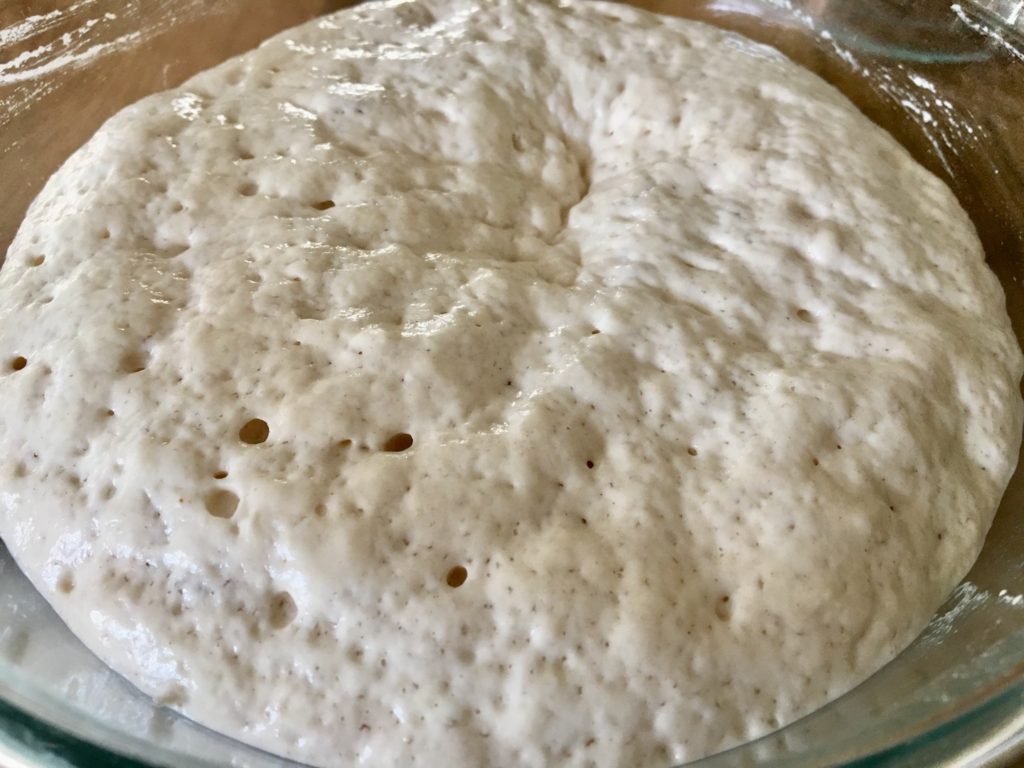
The second proof will be for between 1 and 2 hours, depending on the temperature of your baking space. If it’s 72ºF or lower, it will take closer to 2 hours. If your kitchen is warm, it will take less time.
This is where, if you choose to go for a long aging, you’ll put the dough in the fridge to proof for 1 to 3 days. When you’re ready to make pizza with your chilled dough, let it warm up on the counter for about an hour before shaping it.
Alright. That’s it! Are you ready to make some pizza crust? Do you have additional questions? Please feel free to message me about issues or concerns. Comment below if you’re trying my recipe!

Perfect Pizza Crust
Equipment
- Large Glass Bowl
- Rubber spatula
- Dish Towel
Ingredients
- 250 g bread flour
- 5 g sugar
- 5 g salt
- 7 g active dry yeast (or 1 packet)
- 1 cup filtered water
Instructions
- Measure your dry ingredients into your mixing bowl using a kitchen scale. Tare the scale after ever addition to get exact weights
- Warm your water to 100ºF, it should feel warm to the touch like a nice bath, not too hot.
- Pour half of the water into your dry mix and begin to stir. Add the water slowly. It may take more or less than a cup of water to hydrate your dough. It should form a shaggy mass. It should not be goopy (too wet) or flaky with left over dry ingredients in the bottom of the bow (too dry)l.
- Once all the ingredients are incorporated into a shaggy dough ball, cover with a tea towel and allow the dough to hydrate for 25 to 45 minutes. It will take a little bit longer if your kitchen is cold. If you live in a dry climate, opt for plastic wrap to cover your bowl instead of a towel so the dough doesn't dry out.
- Once the dough is puffy and hydrated (it will rise a little but shouldn't double), turn the dough out onto a clean, dry counter. Slap and fold, rotating the dough 90º on every slap, until the dough becomes smooth and stops breaking and sticking to the counter.
- Swirl the dough ball on the counter to form a tight skin and seal the bottom. Place dough ball back into mixing bowl. Cover and allow it to rise until it has doubled in size. Between 1 and 2 hours.
To Make Pizza
- Place a pizza stone onto the bottom rack of your oven, and preheat to 550°F (or as high as your oven will go) for half an hour.
- Sprinkle cornmeal on a pizza peel and set aside. Cornmeal will act like ball bearings so your pizza will slide easily from the peel to the stone.
- Flour your counter and press the dough out into a round of 14 inch diameter. Optionally, use a rolling pin to get the dough even.
- Move the dough to the pizza peel testing to make sure it does not stick.
- Top your pizza with sauce, cheese, and toppings. Jiggle the peel occasionally to make sure that the dough is not sticking. Work quickly; the cornmeal can become hydrated and sticky.
- Once topped, immediately move pizza from the peel to the stone (see video in notes for how to do this).
- Bake pizza for about 8 minutes or until cheese is browned and crust is cooked and bubbly. Turn on your oven light and watch it. Use the pizza peel to pull your pizza out as soon as it looks done to you.


